Why a Bicycle’s Chain Runs on a Loop
Why a bicycle chain runs on a loop: see how the front chainring, rear sprocket, and linked chain carry pedal effort to the rear wheel.
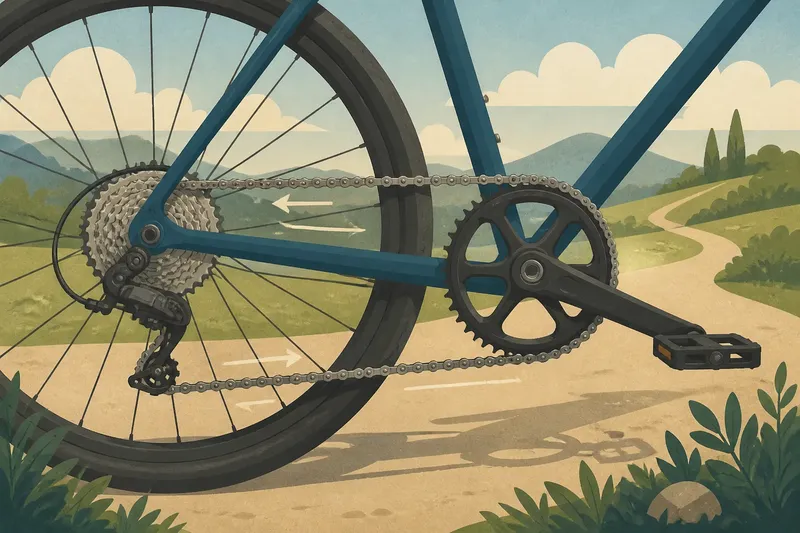
The most common mistake is to think a bicycle chain simply pulls the rear wheel around; that picture leaves out the sprockets that guide the pull and can make an ordinary gear change seem mysterious. Why a bicycle’s chain runs on a loop becomes clear when you follow one link from the pedals, around the rear sprocket, and back again.
The chain’s route
Start at the crank, where the pedals turn. A toothed ring called the chainring is fixed to it. The chain sits on the chainring’s teeth, so the rotating ring draws the chain along its upper run toward the rear wheel.
At the back, the chain wraps around one of the rear sprockets, often called a cog. That sprocket is connected through the rear hub to the wheel. As the chain moves, its links engage the cog’s teeth and turn it; the hub then carries that rotation into the wheel.
The lower run returns from the rear sprocket to the chainring. Together, the two runs form a closed loop. The chain does not run out at the back and start over at the front: each link travels around the circuit again as you keep pedaling.
What the loop does
A chain can transmit turning effort because its rollers settle between the teeth of the chainring and sprocket. The teeth push against the chain as the crank turns. In return, the chain pulls on the rear cog. This is a mechanical connection, not a direct attachment between the pedals and the wheel.
Imagine a rider starting on a bicycle in a middle gear. As the rider presses the pedals, the crank turns the chainring, the chain advances, and the rear sprocket turns the hub. The observable result is that the rear wheel rotates while the chain circulates around its route. If the rider stops pedaling, the chain stops being driven, though the wheel may continue rolling.
That last detail explains why coasting works. A bicycle’s rear hub usually includes a freewheel or freehub mechanism that lets the wheel keep turning while the sprocket and chain are not being driven by the pedals. The chain still links the crank to the selected sprocket, but the wheel is free to overtake that drive when you coast.
Two sprockets, different jobs
The chainring is the front sprocket, attached to the crank. The rear sprocket is part of a cluster of cogs, often called a cassette on bikes with a freehub. On a single-speed bicycle, there may be just one rear sprocket. In either arrangement, the selected front and rear teeth define how crank rotation relates to rear-wheel rotation.
A larger chainring moves more chain for each crank revolution than a smaller one. A larger rear cog requires more chain to pass around it for each revolution of that cog than a smaller one. Those relationships change the feel of pedaling and the distance the wheel turns relative to a crank revolution; the chain’s basic job remains the same.
For a simple comparison, hold the front chainring constant in your mind and imagine shifting the chain from a small rear cog to a larger one. The chain still loops between the crank and rear wheel, but the rear cog turns in a different relationship to the crank. Riders commonly use the larger rear cogs when they want easier-feeling pedaling, and smaller rear cogs when they want a harder-feeling gear.
Why gears need a moving chain
On a derailleur bicycle, shifting moves the chain sideways from one sprocket to another. The rear derailleur guides the chain across the cassette and also takes up slack as the chain travels around cogs of different sizes. With multiple chainrings, a front derailleur can guide the chain between those rings.
The chain must be able to move sideways enough to reach another cog, while its rollers and plates still engage the teeth. That combination is why a shift is a change of route across the sprockets, not a new drive system. The same chain continues carrying the rider’s effort around the loop.
Shifting tends to work more smoothly while pedaling gently rather than forcing the pedals under heavy load. Ease pressure briefly as you shift, then resume a comfortable stroke. On an internally geared bicycle, the chain may stay on one front and one rear sprocket while the hub changes the gear relationship inside; not every bicycle shifts by moving the chain across a cassette.
Chain questions?
Does the chain turn the rear wheel directly?
Not by touching the tire. The chain turns a rear sprocket, which is coupled to the hub and wheel through the bicycle’s drivetrain. The teeth provide the contact that transfers the pull.
Why does the chain have two runs?
The upper run carries the driven pull from the chainring toward the rear sprocket, while the lower run returns to the front. Because the chain is closed, both are parts of one continuous loop of links.
Why does a chain sometimes sag?
Derailleur systems use a spring-loaded cage to manage extra chain as the selected sprockets change. On a single-speed bicycle, chain tension is set by the frame and rear-wheel arrangement, so visible slack may call for an adjustment rather than a gear shift.
Can the wheel turn without the chain moving?
Yes, while coasting on a bicycle with a freewheel or freehub, the wheel can turn independently of the pedals and chain. When you pedal forward, the hub mechanism engages the drivetrain again.
What to notice
Next time the bicycle is safely still, look at the path from the chainring to the rear cog without placing fingers near the teeth. You can trace the upper run, the wrap around the rear sprocket, and the return run beneath it. Then turn the pedals by hand only if the bicycle is stable and clear of anything that could catch in the moving parts.
A clean, lightly lubricated chain tends to run more quietly than one coated in grit or left dry. Use bicycle chain lubricant rather than household oil, wipe away excess with a rag, and follow the product label and bicycle maker’s care guidance. If a chain skips, binds, or repeatedly falls off, a bicycle mechanic can inspect the chain, sprockets, and shifting parts together; the visible loop is only one part of their alignment.
Once you recognize why a bicycle’s chain runs on a loop, gear changes become easier to picture: the chain keeps carrying effort around the circuit, while the sprockets determine how that effort reaches the rear wheel. That is why two bicycles can share the same familiar chain shape yet feel quite different under the pedals.