Before Pneumatic Tires, Bicycle Roads Felt Every Bump
Bicycle history before pneumatic tires reveals how firm rubber, road surfaces, and changing designs shaped comfort, handling, and the appeal of early riding.
The common mistake in bicycle history is to imagine that every early bicycle rode like a modern bike with thin, uncomfortable tires. Before pneumatic tires became widely used, many bicycles relied on solid or minimally cushioned tires, so bumps could travel directly through the wheels and frame. That cost shaped the kind of routes a bicycle suited and the experience its rider could expect.
There was no single hard-tire bicycle or uniform early riding experience. Designs and materials varied, as did road surfaces and riders’ purposes. A high-wheeler used for a smooth course presented different demands from a lower bicycle on a rough country lane. Tires mattered, but they were only part of the bargain among machine, rider, and road.
Smooth street riding
On a reasonably even street, a hard tire could be a workable choice. It offered little cushioning, but the consistent surface reduced the jolts a rider would encounter on broken paving or loose ground. In places where smooth roads were limited, choosing a route could matter as much as choosing a bicycle.
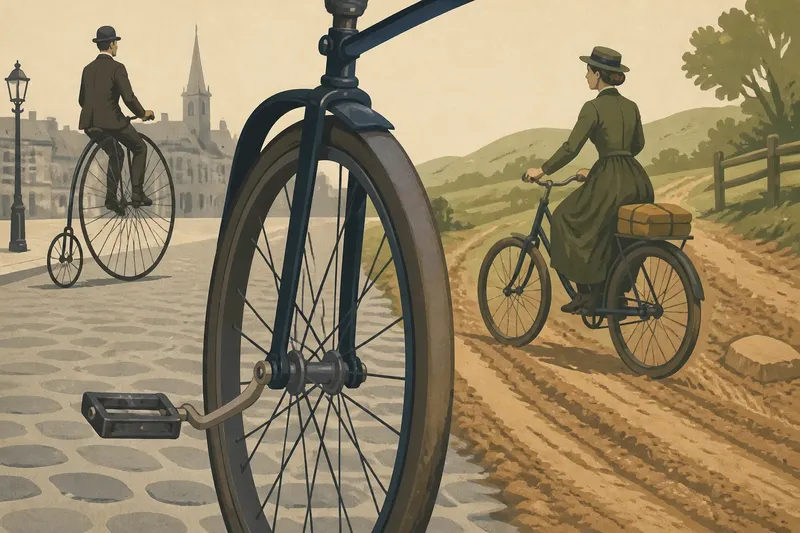
The high-wheeled bicycle, often called an ordinary, made one early design especially recognizable. Its large front wheel put the rider high above the ground. The arrangement could suit practiced riders on suitable surfaces, but a sudden obstruction could be difficult to manage, and a fall from that height could be serious. The exact handling depended on the bicycle and the rider; it should not be treated as the experience of every early cyclist.
For someone riding familiar, even streets, the firm tires and direct feel might be acceptable. On rougher paving, the same bicycle offered little forgiveness. Riders had to pay attention to the road rather than expect the tires to soften every impact.
Rough road tradeoffs
Packed earth, loose gravel, and uneven stone could make a hard-tire ride jarring. How strongly a rider felt that roughness depended on the tire, frame, wheel, and surface. Solid tires could avoid the ordinary punctures associated with air-filled tires, but their limited cushioning was a disadvantage when the ground was irregular.
A rider facing a rough route might choose firmer ground, slow down, or favor a more stable design. Those choices were practical responses to the available machines and roads, not evidence that early cyclists were indifferent to comfort. Someone carrying a parcel or traveling beyond town might reasonably value control and a manageable pace over speed.
Say Clara, in an invented situation, needs to ride from a village to a market. Her route includes smooth paving near town and rutted earth outside it. If she chooses a high-wheeler for the paved section, she may find the rough approach tiring and harder to manage. Instead, she picks a lower bicycle suited to steadier handling, rides slowly over the ruts, and uses a firmer parallel track where possible. The observable result is a more controlled trip, traded against a slower pace.
Speed and spectacle
Some early bicycles served recreation and display as well as travel. The high wheel made its rider conspicuous, and riding it demanded balance and practice. On a suitable smooth course, a skilled rider could make good progress, but the bicycle’s height and handling asked more of the rider than the machine’s appearance alone might suggest.
This helps explain why early cycling could seem exclusive. A bicycle that required a practiced mount and careful control was less inviting to someone seeking simple everyday transport. Skill became part of the spectacle, while the hard ride reinforced the impression that cycling was an adventure rather than an ordinary errand.
The appeal depended on context. A confident rider might welcome a direct-feeling machine on an appropriate route; a cautious rider could see its height and firm tires as obstacles. The distinction was not simply a matter of courage: the bicycle imposed real demands before the journey had properly begun.
The safety bicycle shift
The safety bicycle, with two wheels of similar size and a lower riding position than the ordinary, offered a different arrangement. It was generally easier to mount and gave riders a less elevated posture, though handling and comfort still varied by design. It did not make every road smooth, but it changed the physical demands associated with the high-wheeler.
That shift should not be reduced to a single cause or treated as an instant change in who could ride. The layout made some bicycles feel more approachable for ordinary travel, while tire construction, road conditions, cost, access, and riding skill still shaped people’s choices. Hard tires remained uncomfortable on rough ground even when the bicycle’s overall design was less daunting.
To understand changing bicycle culture, look at the whole machine rather than crediting one component with broad social change. Frame layout, rider posture, wheel proportions, and the roads people used all mattered. The safety bicycle altered the terms of the ride; it did not erase the physical limits imposed by firm tires and rough surfaces.
When did pneumatic tires matter?
What were hard tires made from?
Some hard tires were solid rubber; other early constructions varied. They provided far less air cushioning than pneumatic tires, so the rider often felt more of the road’s texture.
Why did pneumatic tires change the ride?
An air-filled tire can flex over small irregularities, softening some impacts and changing how the wheel meets the ground. It also requires attention to inflation and can be vulnerable to punctures, so cushioning came with different maintenance needs.
Did every early bicycle have a high front wheel?
No. The high-wheeler is a memorable design, not a stand-in for every bicycle of the period. Bicycle forms varied, and the safety bicycle’s lower layout offered another approach to riding.
Were hard tires useful?
They could be simple and avoid punctures from hazards that affect pneumatic tires. On smooth ground, some riders may have accepted their firm feel; on rough ground, the lack of cushioning was a clear drawback.
Reading the ride
Hard tires make an abstract design choice easier to imagine as a physical experience. On rough ground, they transmitted more of the surface to the bicycle and rider; on smoother ground, that firmness could be less troublesome. Neither response was universal, and tire construction alone cannot explain how a bicycle handled.
When looking at an early bicycle in a museum or illustration, notice the rider’s posture, wheel proportions, and likely route together. That combination offers a more careful picture than assuming every early cyclist rode the same kind of machine. A hard tire was part of a larger bargain between the road, the bicycle, and the person willing to ride it.
For bicycle history, the most useful question is not whether an early design was simply good or bad, but what kind of ride it made possible. Firm tires, bicycle layout, and road conditions each shaped that answer—and none should be mistaken for the whole story.